

Solar Matters: Is Eco-Worthy UL 9540 certification a game changer for Canadians?
On April 16, 2026, Eco-Worthy was granted UL 9540 Certified Inverter Pairing certification by Intertek, allowing Eco-Worthy to sell the combination of the 5,000 watt 120 VAC inverter, and their Cubix 100 battery as a Canadian Electrical Code compliant ESS (Energy Storage System) for Canadian homes. On May 7, 2026 Intertek gave them “Authorization to Mark” that allows Eco-Worthy to place the cETLus nameplate and Intertek reference number on the Cubix 100 battery and the 5,000 watt inverter.
This is a big deal. Eco-Worthy, widely believed to be a “budget solution” for do it yourselfers, has suddenly become credible. Their inverters and batteries will now carry the cETLus “mark”. When a licensed electrical contractor goes to pull the permit, the municipality’s planning and development department won’t burst out laughing.
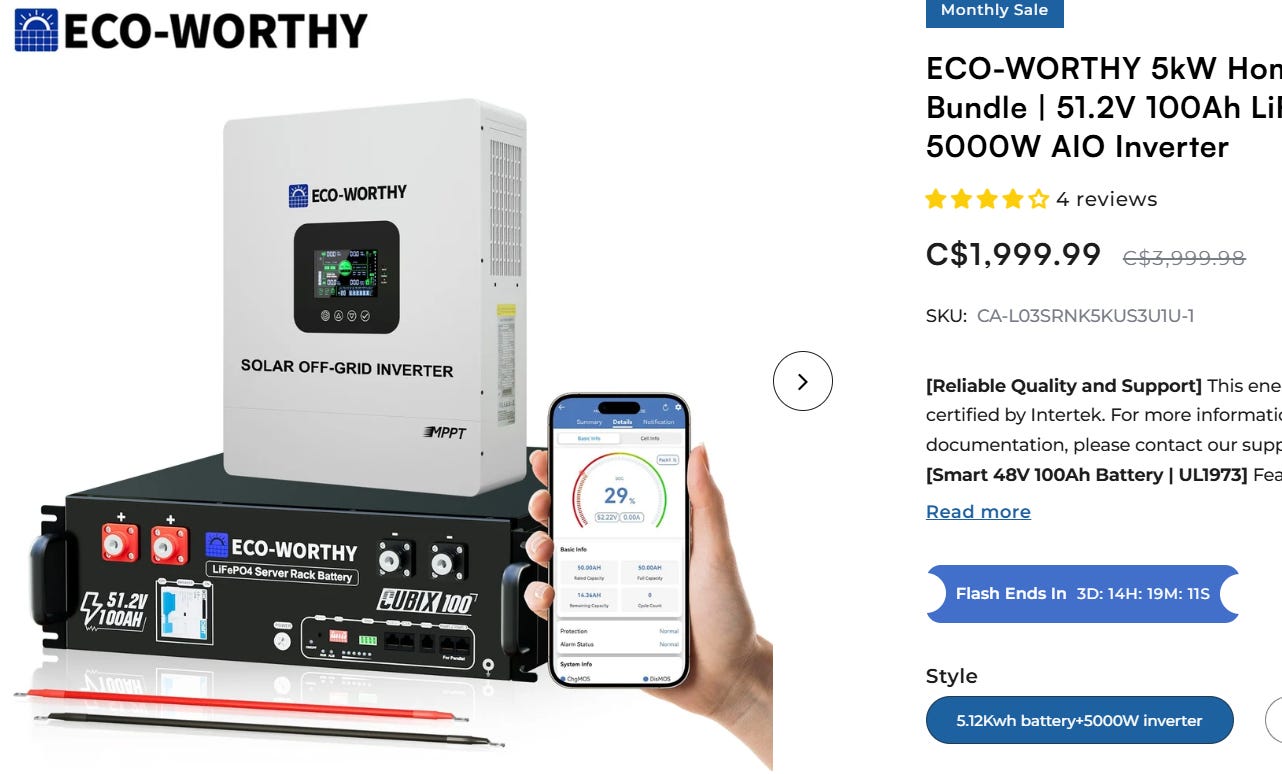
If you look on Eco-Worthy’s web site they have a bundle. For $1,999 Canadian, you get the 5,000 watt inverter and a Cubix 100 battery. The text on the site says “This energy storage system is UL 9540 system-level certified by Intertek. For more information or to request compliance documentation, please contact our support team. “
I can tell you that Eco-Worthy was kind enough to send me their “Authorization to Mark” that matches the UL 9540 video on their Youtube channel.
Wow, fully CEC compliant Energy Storage System for $2,000. That is a game changer.
Or is it?
The devil is in the details
Let’s go to the source. If you go to the Intertek Directory of Listed Products and search for “Xiamen Eco-Worthy Electronic Co., Ltd UL 9540”, you’ll find pages of references. Look in the right column. You want the one marked ANSI/CAN/UL-9540.
When you click on that line, you might expect to get some report talking in depth about what testing was done and what the results were. But, it’s nothing like that.
Instead what you get is a page of gibberish that looks like a bowl of alphabet soup and an Enigma machine had a baby.
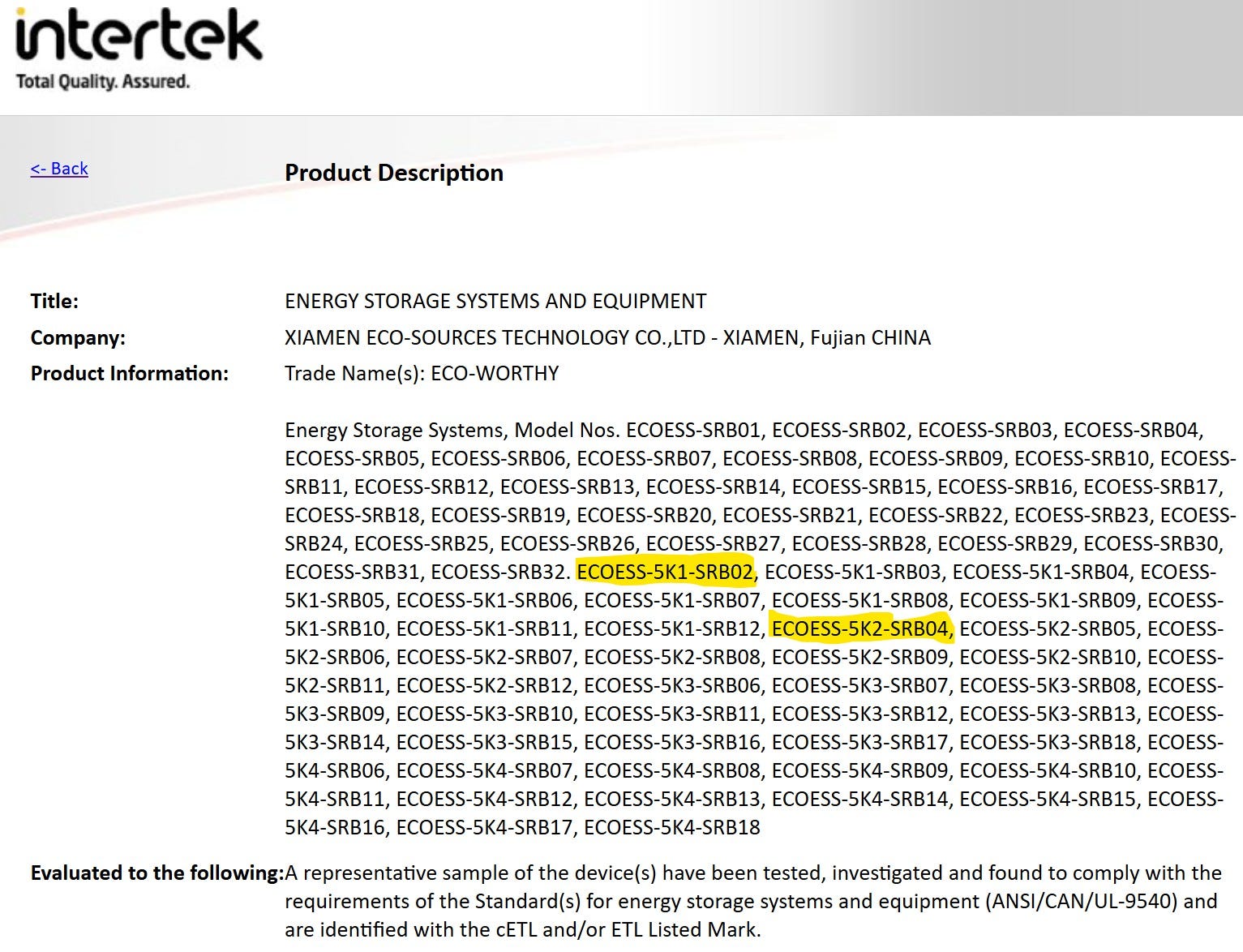
Let me help you out. The thing you are looking for is “ECOESS-5K1-SRB02”
I want to point out there is no “ECOESS-5K1-SRB01.”
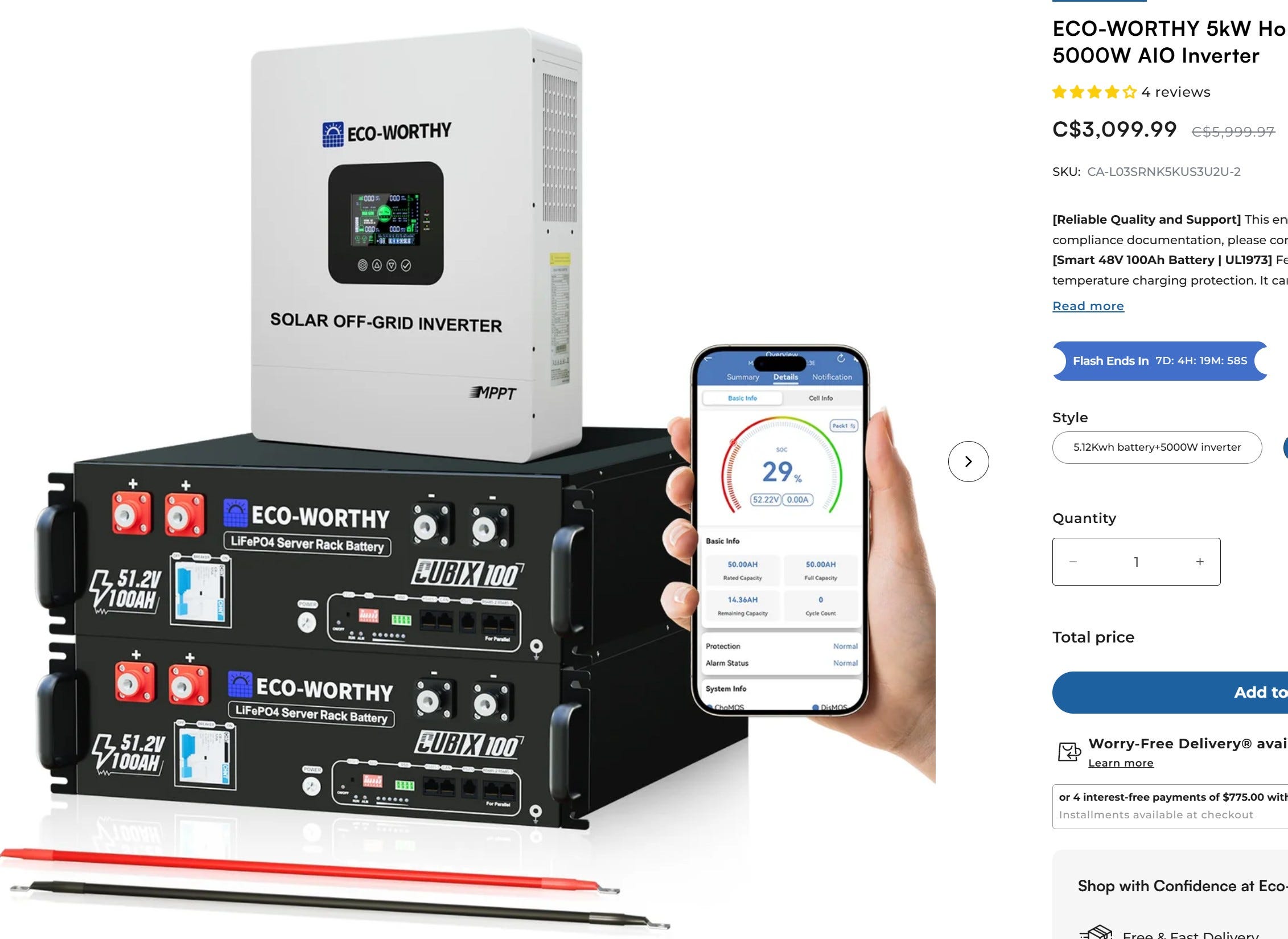
Why does that matter? This is telling us that the MINIMUM UL 9540 Certified Inverter Pairing is the 5,000 watt inverter (5k1) and TWO Cubix 100 batteries.
That makes complete sense. A 5,000 watt inverter with a surge capacity of 10,000 watts can exceed the 100 amp rating of the BMS. So, to ensure that the inverter does not shut down in normal operation, we need a battery bank that can produce more than 100 amps. Simple. A single Cubix 100 battery is not part of the certified ESS, even if it might work electrically.
But, if you are counting, this is now a $3,100 solution with two batteries sitting on the floor. (No rack or mounts and there is a reason for that, and that reason is called UL 9540A Thermal Runaway Fire Propagation.)
Let’s look at the closest equivalent competitor for a UL-9540 certified pairing - EG4 - PP-48-280A1-6KXP1-IN-. Converting gibberish to English, that is their 6000XP off-grid inverter with the 280 AH wall mount battery. (It’s worth pointing out that EG4 does not have a UL 9540 certification for their 100 AH server rack battery.)
That’s “EG4 Electronics UL-9540” if you are playing along at home on the Intertek site.
This particular bundle is from Canadian Off Grid and does not include shipping. These prices should be the right order of magnitude in Canada.
EG4 48V 120/240VAC 6000XP split phase off-grid inverter,
EG4 280AH 48V (14.3 kWh) Wall Mount Battery,
EG4 Indoor Conduit Box $5,975 + Shipping
Let me just point out a few key differences.
The EG4 6000XP is split phase 240/120V
Higher output of 6,000 watts (12,000 surge)
Dual MPPT (2 x 4,000W PV input)
Contains a full set of DC and AC circuit breakers.
Includes advanced features like AC coupling.
The battery has fire suppression and self heating.
Overall, an extra 80 AH of capacity. (4.096 kWh)
No battery rack required. (Mount it on the wall)
Allegedly, some of the best tech support in the industry.
Massive support in the DIY community.
The battery is UL 9540A certified! (This is really important and UL 9540A and UL 9540 aren’t the same thing so it’s not a typo.)
A more “apples to apples” comparison would be the Eco-Worthy 5,000 Watt inverter, and three Cubix 100 Pro batteries - and the Cubix 100 Pro is not currently UL 9540 listed (or even available in Canada as of this writing.)
To conclude this section, in round numbers, since Eco-Worthy is including shipping and Canadian Off Grid is not, being forced to buy a bigger battery makes the EG4 solution cost about twice as much.
But let’s put that in context. For “half the price” you get
no split phase 240 V
1,000 watts less output
single MPPT charge controller
80 AH less storage (4096 kWh)
no fire suppression
no UL 9540A propagation control
Is 5000 watts “big enough”?
Let’s consider that.
I believe most Canadian homes have natural gas heating and a natural gas water heater so 240 V electric heat I am going to say is “uncommon”.
Since this Eco-Worthy inverter is not 240V split phase, you are not running your stove, clothes dryer or central air conditioning on this.
That leaves a lot of 120V loads you can run on this unit. For many Canadians, an inverter that can handle 5,000 watts is probably “lots”.
Eco-Worthy batteries can’t be stacked.
This is the part DIY’ers miss. None of these server‑rack batteries can be vertically stacked because they are not UL 9540A, and therefore fall under CEC 64‑218 spacing rules.
To channel Dr. Seuss:
Not in a rack, not in a stack,
Not above or below — that’s a fact.
Set each one where it’s clearly seen,
And keep one metret in‑between!
Since no Eco‑Worthy battery is UL 9540A certified, they fall under CEC 64‑218, which requires:
batteries separated horizontally by at least 1 metre.
no vertical stacking
no shared enclosure
no shared thermal envelope
But what if I need 240V?
This is where it gets interesting.
Yes you can do this. Eco-Worthy allows up to six of these 5,000 watt inverters to be paired, increasing capacity to a total of 30 kW and allowing split phase 240/120VAC. This “parallel inverter” architecture is exactly the same used by companies like Victron Energy. It’s also worth noting that once you use a pair of these to get 240V, you have to upgrade in pairs. So if you have 10,000 watts capacity and you need 15,000 watts, you are adding two more inverters. (Which will give you 20 kW).
So yes, you can put two Eco-Worthy 5,000 watt inverters in parallel to get 240V split phase, and 10,000 watts of total output capacity.
But, as said earlier, the devil is in the details. Let’s go back to Intertek.
COESS-5K2-SRB04 What does that mean? Let’s translate to English again.
Two 5,000 watt inverters and FOUR Cubix 100 batteries.
The bottom line is that if you want to get 240V from your Eco-Worthy system, and still be CEC compliant, you’re not only adding a second inverter, but you are adding two more batteries. You’re welcome.
Now this is a $6,500 solution.
Suddenly, that $6,500 EG4 solution doesn’t look ridiculous.
Conclusion - The place you get tired of thinking
In my opinion, Eco-Worthy has done a really good job at releasing a fully CEC code compliant configuration that meets the Canadian requirement that residential ESS systems must have a UL 9540 Certified Energy Storage Systems.
It’s a pretty inexpensive way for a Canadian to get started with an ESS, as long as you understand what will be required if you have to scale it to more output or 240 Volts.
I want to add my two cents though.
If I were Eco-Worthy and I was serious about the Canadian market, and, I think by their behavior they have shown they are, I would:
Get a split‑phase inverter certified to UL 9540.
Get a UL 9540 certified pairing with your inverters and the Power Mega 16 kWh wall‑mount battery.
Get UL 9540A certification for the Power Mega battery.